Overview of the Theatre Production Process
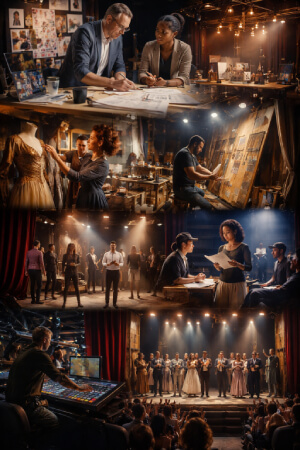
A concise route from script to stage is not a single line, as theatre creation is a sophisticated multiple weaving thing. At every step, dynamics are added to the prior ones: arguments are left with possible changes if necessary. It is the gradual combination of creativity and steps of logic that really interlocks with a production in progress; if so, some of your thoughts and approaches have got to be altered so that an apt situation will be taken directly instead. The process shows great variance in terms of any given lesser price and a certain potential.
From Idea to Initial Concept
Very few stage productions work without a script (though they occasionally start instead with a concept, historical event, or theme around which living will be said). The earliest discussions are concerned with reasons why this story must be told and how the telling might be done. At this stage, directors and producers often collaborate to settle the tone, setting, and audience expectations.
These discussions lay the foundation for a common vision. They erect practical hurdles, such as financial constraints or available venue size, in front of creativity for the next few months. These decisions made in the embryonic discussions have such power to forge the full process.
Planning and Scheduling
Once a concept is defined, practical planning becomes unavoidable. Rehearsal schedules, production timelines, and staffing needs are mapped out early. This planning ensures that creative work has enough time to develop without overwhelming the team.
Scheduling also reflects the realities of theatre work. Many artists juggle multiple projects, so coordination is essential. Clear timelines reduce uncertainty and allow collaborators to focus on their specific tasks.
Development Phases in Theatre Production
Development phases allow ideas to be tested before they are locked into place. These stages encourage experimentation while limiting risk. Not every production includes every phase, but most pass through several forms of structured development.
These phases are often iterative rather than final. A workshop may lead back to rewriting. A preview may reveal issues that require changes in design or pacing. Theatre grows through this repetition.
Research and Script Development
Research supports both new writing and reinterpretations of existing work. Writers and directors may study historical sources, previous productions, or cultural contexts. This research informs character choices, language, and staging ideas.
Script development often continues alongside research. Scenes are revised, reordered, or removed as the story becomes clearer. This stage can last weeks or years depending on the project.
Workshops and Readings
Workshops provide a low-pressure environment to explore material with actors. Scenes are tested aloud rather than fully staged. This allows creators to hear how dialogue works and where pacing slows.
Readings serve a similar purpose but are usually shorter. They help identify strengths and gaps without committing resources to full production elements. Feedback gathered here often leads to significant changes.
Rehearsals and Previews
Rehearsals are where the production takes physical shape. Blocking, character work, and scene transitions are refined daily. Designers introduce elements gradually so performers can adjust.
Previews place the work in front of an audience before opening night. Audience reactions offer valuable information. Laughter, silence, or restlessness can prompt final adjustments.
Touring and Remounting
Some productions continue beyond a single venue. Touring introduces logistical challenges such as adapting sets to new spaces. Performers also adjust their work to different audiences.
Remounting occurs when a production is revived after time away. While the core remains the same, changes are often made based on past experience. Theatre rarely stays frozen.
Common Roles in Theatre Production

A theatre production depends on collaboration across many roles. Each role carries specific responsibilities, but communication between them is constant. Success relies less on hierarchy and more on coordination.
These roles exist in nearly every production, though titles and scope may vary. Smaller productions often combine responsibilities, while larger ones distribute tasks among specialists.
Creative Leadership Roles
The director guides the overall interpretation of the work. They coordinate performances, pacing, and visual storytelling. Their role is both artistic and practical.
Playwrights or writers shape the text and often remain involved during development. Designers for sets, costumes, lighting, and sound translate ideas into physical form. Their work defines the world of the play.
Production and Technical Roles
Producers manage the budget, contracts, and logistics of production, divided in trying to keep the artistic free flow to run without having to obey actual logistical and monetary realities. They have the power to play with time.
The technical crew, as well as stage managers and stagehands, function with many tasks in a play to support behind the scenes. Whereas stage managers are a valuable tool for communication during rehearsals and performances.
How Collaboration Shapes the Final Production
Theatre is built through ongoing dialogue. Ideas are proposed, tested, revised, and sometimes discarded. Collaboration allows individual strengths to support a shared goal rather than compete for attention.
Disagreements are part of the process. They often lead to stronger outcomes when handled openly. Theatre development depends on trust and the willingness to adapt.
Balancing Vision and Practical Limits
Every production faces constraints. Time, money, and space all affect what is possible. Creative teams learn to work within these limits rather than against them.
Limitations can prompt unexpected solutions. A simplified set or altered staging may reveal new meaning in the material. Constraints often sharpen focus.
Audience as Part of the Process
Audiences influence development more than many realize. Previews and early performances offer insight that no rehearsal can replicate. Audience energy changes timing and emphasis.
This relationship continues throughout a run. Performers adjust subtly each night. Theatre remains responsive long after opening.
The Path from Development to Performance
At the end of the long road, into opening night, lies infinite decision and revision before the curtain rose. The seamless facade observed on stage may conceal months of uncertainty and change experienced in the wings.
However, even then, it has not ended. Continually morphing, performances evolve with response and lived experience. Theatre develops from a spirit rather than a phase.
Regardless of how certain individuals in a production all see it, the opening marks a commencement stage. Thereafter, the focus lies on a relentless finishing and sustaining work at any given show.
With time in operation, the production has its embellishments. Since the changes are still obscured, they keep on evolving, so how do you step in without killing this connectivity? It's just alive longer and ends the moment the work is executed.
Final Curtain Thoughts
Theatre productions are shaped through a gradual process that values exploration as much as execution. From early research to touring performances, each stage contributes to the final experience.
"Shooting is writing, editing is writing, preproduction is writing, and auditioning for the cast is also writing. Improvisation is also part of writing."
— DepressedBergman (@DannyDrinksWine) December 27, 2023
--- Edward Yang
Full Excerpt:
"To me writing and directing go hand in hand. You can't separate the two responsibilities.… pic.twitter.com/cIOwVt5mbT
Ever wondered what goes on behind the scenes of a theatre production? 🎭✨
— Royal Welsh College of Music & Drama (@RWCMD) September 24, 2025
Step into the world of a #RWCMDStageManagement student and follow the production process through their eyes 👀👇#RWCMDCreative #RWCMDStageManageent #StudyInWales #StudyInCardiff pic.twitter.com/SWDp5HReWB